
How Accurate Is a 3D Smile Simulation for Veneers?
If you’re considering porcelain veneers, one of the hardest parts can be imagining what your new smile will actually look like.
You can look through before-and-after photos. You can bring inspiration pictures to your consultation. You can talk about wanting your teeth to look longer, brighter, softer, or more symmetrical. But until you can see those changes on your own face, it can be difficult to know whether a particular smile design truly feels like you.
That’s where modern 3D smile simulation has changed cosmetic dentistry.
At Peninsula Center of Cosmetic Dentistry in Los Altos, CA, we use 2D and 3D smile simulations to help patients visualize potential results before moving forward with veneers. Today’s technology can create an impressively realistic representation of what we can accomplish, but the simulation is only one part of a much more detailed smile design process.
How Accurate Are Today’s 3D Smile Simulations?
Smile simulation technology has come a long way.
Years ago, digital simulations weren’t necessarily something we wanted to show patients. The results could look artificial and often didn’t accurately represent what high-quality porcelain veneers could accomplish.
Today, that’s completely different.
Modern simulations are significantly more realistic, both in the way they render the teeth and in how accurately they can represent the changes we’re considering. We now use 2D and 3D simulations regularly because they give patients something incredibly valuable: context.
Rather than looking at a model of teeth and trying to imagine what those teeth might look like in your mouth, you can see the proposed smile within your own face.
That makes it much easier to answer the questions that actually matter: What will this look like on me? Does this feel natural? Is this the change I’m looking for?
2D vs. 3D Smile Simulation
A 2D simulation can begin with something as simple as a photograph.
A patient can provide a clear photo or selfie, and we can create a digital representation of how changes to tooth shape, proportion, alignment, or color could affect the overall smile. It’s a simple way to begin exploring what’s possible without requiring a full clinical workup.
A 3D simulation takes the process further.
When you come into Peninsula Center of Cosmetic Dentistry, we can take detailed photographs along with a digital scan of your teeth. Those records can then be combined to create a more complete digital model.
Now we aren’t simply changing teeth in a photograph. We’re incorporating actual information about your existing tooth position, shape, bite, and anatomy into the design.
That allows us to create a much more accurate representation of what we can accomplish from both an aesthetic and functional perspective.
Your Smile Has to Work With Your Face
Patients often come into a cosmetic consultation with inspiration photos, which can be extremely helpful.
Maybe you love a celebrity’s smile or saw a veneer case online that immediately caught your attention. Those references tell us something about what you’re drawn to.
But that doesn’t necessarily mean the exact same smile will look right on you.
Your ideal smile has to work with your individual features, including your lips, facial shape, skin tone, facial proportions, and even the position of your nose.
Digital simulation allows us to explore those differences before treatment begins.
We can create a version of the smile you think you want and see how it translates to your face. Sometimes patients immediately love it. Other times, seeing it digitally helps them realize that what looked beautiful on someone else isn’t quite right for them.
That realization is incredibly useful because it moves the conversation from, “I want that smile,” to, “Here’s what I actually like about that smile.”
That’s where truly personalized smile design begins.
Cosmetic Dentistry Is Both Objective and Subjective
There are established principles we use when designing a smile. Tooth proportion, function, bite, facial symmetry, and the relationship between the teeth and lips all influence the design.
But there’s also an inherently subjective side to cosmetic dentistry.
One patient may prefer slightly rounded teeth and softer edges. Another may like a more squared, structured appearance. Someone may want a bright, highly polished smile, while someone else wants subtle variations that make their veneers almost impossible to distinguish from natural teeth.
Neither preference is necessarily more correct.
Our job is to first create a design that makes sense aesthetically and functionally for the individual patient. From there, the simulation becomes a starting point for conversation.
You get to react to what you see.
We can discuss what feels right, what doesn’t, and which small details should change before we ever get to the final veneers.
Can You Actually “Test Drive” Your Veneers?
In certain cases, yes.
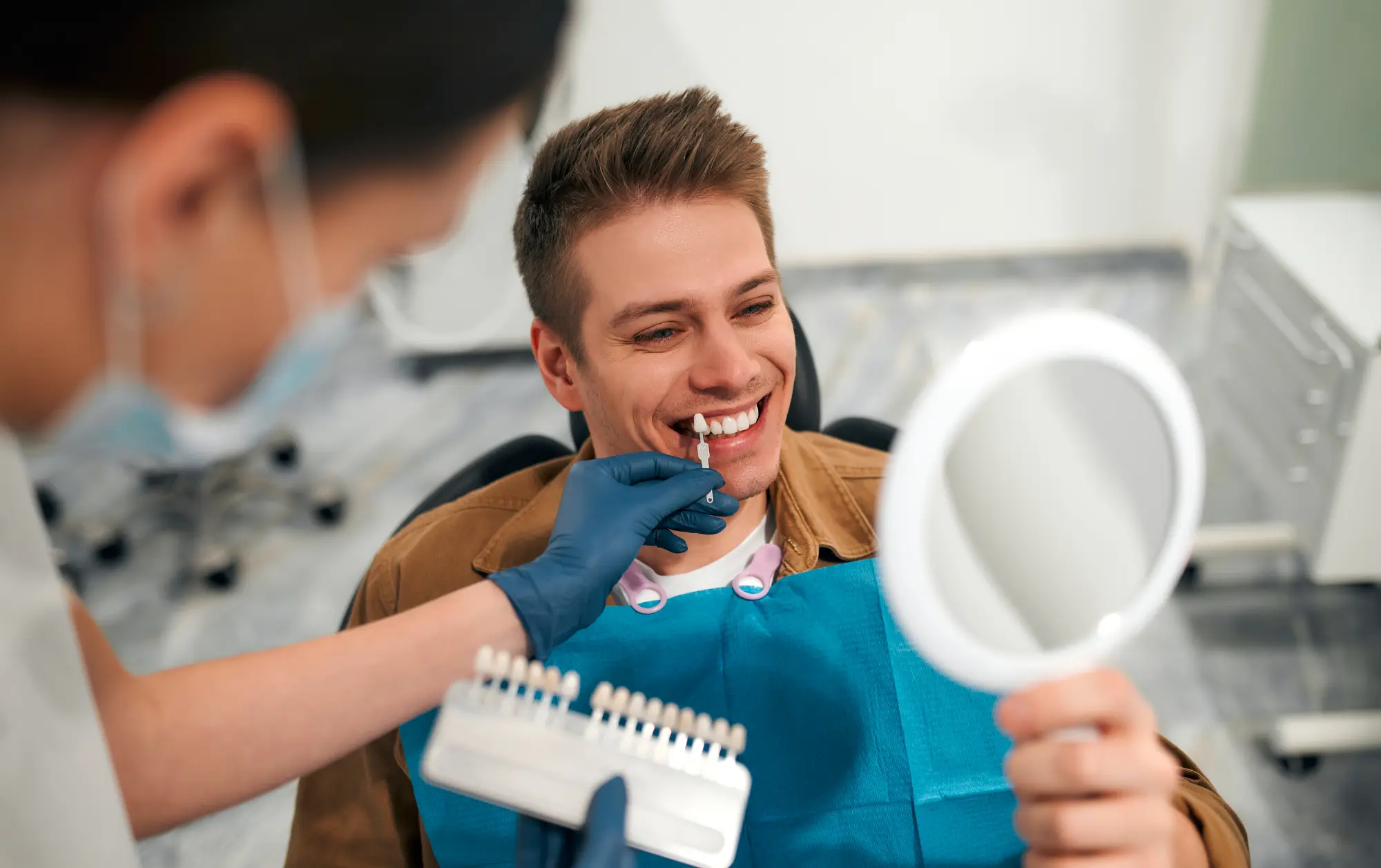
The next step beyond a digital simulation is what we call a smile test drive. Instead of viewing the proposed changes on a screen, we create a physical mockup directly over your existing teeth.
This can be especially effective for patients who are candidates for minimal-prep or no-prep veneers.
Because the mockup is placed over the existing teeth without drilling or removing tooth structure, it works best when the planned smile design is primarily additive. In other words, if we’re adding volume, adjusting shape, or building certain teeth outward, the mockup can provide a compelling preview.
You can actually look in the mirror and experience the new proportions within your own smile.
However, a physical mockup does have limitations. If teeth need to be reduced, repositioned, or significantly reshaped, or if we’re working around existing crowns or decay, placing material over the existing teeth won’t perfectly represent the final result.
That’s why we choose the preview method based on the individual case rather than relying on one technique for everyone.
The Temporaries Are Another Important Part of Smile Design
Even with sophisticated 3D technology, there’s something different about actually living with a new smile.
Once treatment begins and temporary restorations are placed, patients get another opportunity to experience the design before their final porcelain veneers are completed.
We typically encourage patients to spend a few days with their temporaries before making judgments. Remember, you may have lived with your current smile for decades. Even a positive change can initially feel unfamiliar.
Once you’ve had time to acclimate, your feedback becomes incredibly valuable.
Maybe you want an edge slightly softer. Perhaps a tooth feels a little too long. You might describe something in everyday terms that doesn’t sound particularly “dental,” and that’s completely fine. Our job is to translate what you’re seeing and feeling into specific design adjustments.
By the time we move forward with the final porcelain, we’ve already had multiple opportunities to refine the smile.
What If You Don’t Like Your Simulation?
That can actually be one of the most valuable outcomes of the entire process.
Occasionally, we’ll create a simulation and a patient will look at it and say, “That’s not what I had in mind.”
Great. We want to know that now.
Finding out at the simulation stage gives us an opportunity to understand where our visions differ. Maybe we misunderstood a preference. Maybe the patient wants a different style. Or perhaps what they’re hoping to achieve simply isn’t realistic based on their anatomy or dental health.
Those are much better conversations to have before treatment begins.
A simulation shouldn’t be designed to convince you to get veneers. It should give you enough information to decide whether veneers and the proposed result are actually right for you.
Predictability Comes From the Process
So, how accurate is a 3D smile simulation for veneers?
Today’s technology can be remarkably accurate, but predictability doesn’t come from technology alone.
It comes from combining digital simulation with detailed photography, 3D scans, thoughtful treatment planning, facially driven smile design, patient feedback, and, when appropriate, physical mockups and temporary restorations.
At Peninsula Center of Cosmetic Dentistry in Los Altos, CA, we approach that process systematically because veneers are highly personal. We don’t want patients simply hoping they’ll like their new smile when the final porcelain is placed.
We want to have those conversations much earlier.
By seeing your potential smile, refining the design, and understanding what is realistically achievable before the final veneers are created, you can move forward with much greater confidence.
Because the goal of a smile simulation isn’t simply to show you prettier teeth. It’s to make sure the smile we’re designing feels like it belongs to you.
Ready to Preview Your New Smile in Los Altos, CA?
If you’ve been considering veneers but want to feel confident before making a decision, a digital smile simulation can help you see what’s possible before treatment begins. At Peninsula Center of Cosmetic Dentistry in Los Altos, CA, we combine advanced technology with personalized smile design to create results that feel natural, intentional, and uniquely yours. Schedule a cosmetic consultation today to explore your options and take the first step toward a smile you’ll feel excited about.
